Day 3: Tuesday, June 16th 2026
On behalf of the entire Faith in Practice team, we want to thank all of our friends and family for your love and support that makes this mission possible. We miss you dearly, but are also incredibly grateful to be able to say we have extended our families to a wonderful group of people who are here on the mission with us.
Please reach out to a FIP team member regarding Casa de Fe orders by the end of the day on Wednesday, June 17th! Casa de Fe provides a free haven for many of our surgical patients, and you can leave a custom tile in the home with a message spreading hope to all the residents, or have a meaningful, handmade souvenir from one of our FIP residents. Your contributions truly are what keep FIP operating, and we all extend our deepest thanks to everyone who has made this possible.
Tony began this morning’s reflection, as usual, with a few moments of silence and meditation, illustrating an analogy and asking us to become aware of ourselves and our innermost thoughts. Reflection was brief, but just as meaningful as always. Tony guided us to imagine waking up in the middle of the night to a mosquito buzzing by our ear, jolting us awake to swat it away. He encouraged us to treat our negative thoughts as we would treat a mosquito in the middle of the night: to instinctively catch, challenge, and change anything negative that comes our way. It is through this revelation that we can catch our negativity, challenge those thoughts, and change them into positive ones to do good in the world.
Once at the hospital, the team divided into the operating rooms to set up for the upcoming schedule, the wheelchair clinic to begin the day’s work, and the ward to round on patients from the day prior. All the patients in the ward recovered well from their surgeries, and when asked about their pain levels, one patient told Angela, “I feel like I can run, sing, and dance.” To which Angela comedically replied, “Please don’t.” The two shared a laugh, but got serious and emotional when the patient said, while welling tears in her eyes, “Thanks to God you were here to do my surgery, it’s going to change my life.” Many of the patients in the ward shared this sentiment, and none of them complained of any residual pain from their operations. Rocky explained that because they don’t take over-the-counter medications like ibuprofen or acetaminophen for pain regularly, as we do in the U.S., they are much more receptive to common drugs without the need for narcotics. This also served as a testament to the strength and perseverance of the patients, as they must have been suffering from incomparably more pain before their surgeries in comparison to their post-operative pain.
The gynecology operating room (OR) was jointly run by Dr. Canty Wang and Dr. Angela Nishio, who had a fourth last-minute complicated case added on to their schedule by Fito the morning of. This case would leave the whole team, as well as the PACU staff, caught up in the OR after hours for the second day in a row. Every gynecologic surgery today has its own unique complication that would not have been possible to solve without the care of the rest of the surgical team, consisting of Carissa, Lauren, and Chris. For example, because of the rampant gastroenteritis sweeping through our team, Lauren, a registered nurse (RN), had to step completely out of her element and fill in as the scrub tech for the gynecology team.
Many of our team members have been filling unfamiliar roles to keep operations running, including Lauren, Rocky, and Dana. As Tracey mentioned earlier this week, these missions force you to innovate and grow by pushing you out of your comfort zone, and it is a beautiful thing to grow while helping others. Neither Chris, the anesthesiologist, nor Carissa, the RN, normally works in gynecologic surgery, but they were able to grow and adapt to every curveball that they were thrown. By the end of the day, the team had not only adapted their skill sets to work together but also formed the kind of deep friendship that only comes from troubleshooting together. Despite being in unfamiliar roles, on a late schedule, and facing seemingly insurmountable complications, the team closed their last patient while all singing Bohemian Rhapsody together. Lauren, Carissa, Canty, and Angela all sang melody, while Chris sang the harmony.
The three general surgery ORs were run individually by Dr. Tracey Childs, Dr. Brian Diskin, and Dr. Dan Nadig. Fito reviewed all 13 cases and arranged a comprehensive schedule to assign operations to surgeons specializing in the respective procedures. Tracey’s OR was dedicated to two gallbladder removals and two cyst excisions; Dan’s schedule was packed with five hernia repairs; and Brian’s schedule consisted of four operations that were a mix of both.
Dan’s first surgery was ruled a hydrocelectomy during pre-op and evaluation, but once the patient was opened, it was clear that this case would get much more complicated. Dan explained, “Sometimes you don’t know what you’re dealing with until they’re open on the table in front of you. You have to be able to think quickly and adapt to any situation.” And this is exactly what he and his team did. With exceptional team effort and talent, Dan, Rebecca, Lillian, and Kristina reoriented themselves and prepared for a surgery entirely different from what they had expected. Due to this complication, and being scheduled for over 10 cumulative hours of surgery, the last few hernia repairs on their schedule had to be distributed among the other general surgeons.
Tracey’s OR finished their four cases earlier than the rest, which I attribute to her absolute chemistry with her scrub tech, Karina, and anesthesiologist, Telfer. Watching Tracey and Karina operate together was like watching a married couple in a ballet, where Telfer, Dana, and I were all audience members watching them on stage. They would poke fun at one another and bicker and banter, but the surgical process was impeccably elegant, and they communicated without having to ask aloud. Tracey would clean her instruments on Karina’s glove, and in retaliation, Karina would toss a lap pad right on top of Tracey’s hand as she was reaching for her next instrument. However, I have never seen a team of healthcare professionals make a gallbladder removal look so graceful. Before the surgical room had a patient in it, Telfer had all the anesthetics set up and ready to go, and Karina had the trays organized to a T as they both knew exactly what would be needed for each unique case. This team ended up taking on an additional bilateral herniaplasty case, and they collaboratively significantly improved another individual’s quality of life.
Brian’s OR ran relatively smoothly, considering the complications that some of the other ORs faced. Brian is currently a surgical fellow at Providence Saint John’s, and this is his first mission with FIP. His work ethic and ability to cooperate with his surgical cohort have made him an integral and successful part of the team. Madeline APN-CRNA, DNP, and nurse anesthetist covered this OR all day for anesthesia, and none of it would’ve been possible without the assistance of Kat and Jamie. Anyone would find it hard to believe that it was this surgical team’s first time scrubbing together. On top of their busy schedule, the team also performed an additional bilateral hernia repair, which Dan and Brian tag-teamed for maximum efficiency.
After waking up at 6 am for reflection and heading to the hospital at 7 am for 12 hours of nonstop work every day, it would not be surprising if team members grew sick of each other. However, it seems the entire team has chosen the alternative pathway: to become closer and support one another. It would be so easy for us to let negative thoughts and hopeless complications get us down in these cases, but our surgical teams followed Tony’s advice. They caught, challenged, and changed the outlook on every situation. I hope that despite sickness, complications, and long days that life may throw at us, we will all continue to instinctively swat away negative thoughts and cling to each other for positivity and support. So far throughout the trip, it seems like every tragedy has brought us closer to one another, and we have grown into a tight-knit community in the few days we have been together.
Sarah Ty, Blogger
Across the hospital, the mobility clinic team, physical and occupational therapists Jany, Julie, and Elizabeth; medical provider Dr. Joe Austin; interpreters Jeanine and Sarah; triage volunteer Aiden; and mobility equipment assemblers Tony, Mitchell, and Veronica, continued to distribute equipment and care to 30 people. However, equipment supplies are running low. By lunch, all walkers had been given out, and only 13 small and 1 medium wheelchairs remained. Nevertheless, the team continued to push through and provide care to all those who traveled seeking help.
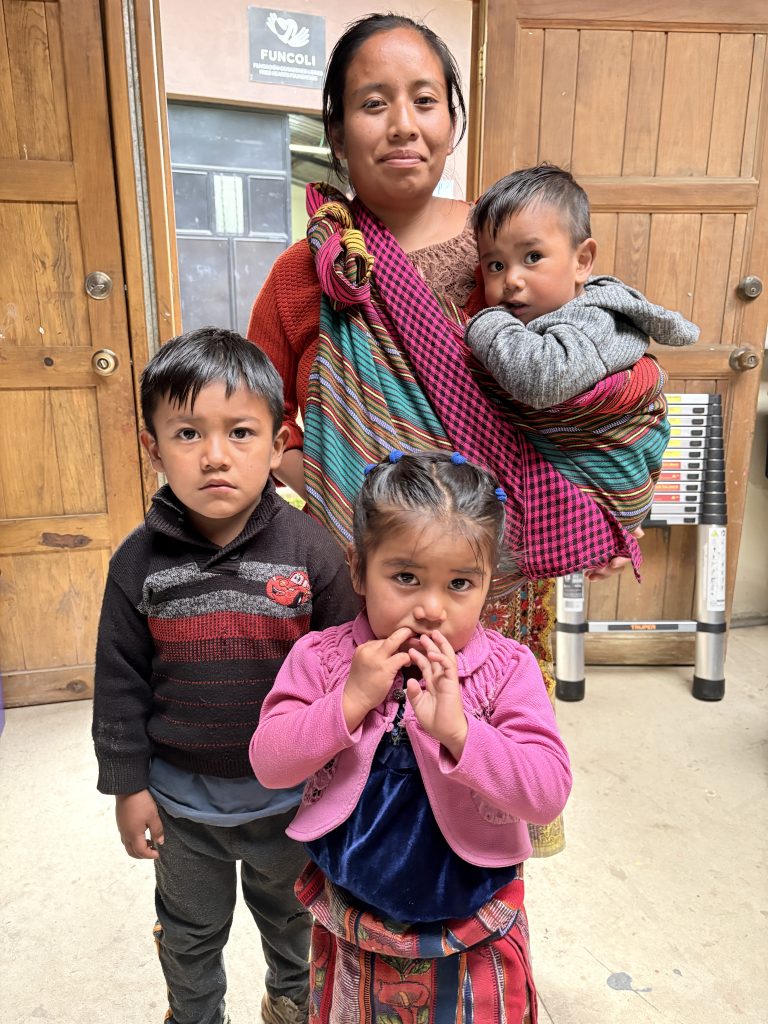
I met Alfredo, whose severe spinal curvature has greatly limited him. His mother states that he is unable to speak, but he can see and hear clearly. He loves listening to music and will shimmy to the beat.
His condition developed throughout his childhood, and because he cannot walk, his family carries him wherever they need to go. As he continues to grow, this has become increasingly difficult as he is now almost as tall as his mother.
When Alfredo’s spine first began to curve, his mother took him to see a therapist, but there was little they could do for him. She is a single mother who works while caring for Alfredo and her 10-year-old child. Her eldest son helps out whenever he can.
Physical therapist Jany showed Alfredo’s mother exercises and positioning techniques that she could continue practicing with him at home. She was relieved to receive practical guidance that might improve his comfort and help preserve his movement.
Still, our team faced a painful limitation. We had no pediatric wheelchairs or other appropriately sized adaptive equipment available for Alfredo. Although we wanted to provide more support, we did not have the supplies needed to meet all of his mobility needs.
Alfredo’s mother has carried him, both literally and emotionally, for years. Although our team could share knowledge and encouragement for one day, she will continue carrying that responsibility long after we leave.
Later, as I moved through the clinic, I saw translator Jeanine stop in her tracks when she saw Rosa, an 80-year-old woman in a wheelchair who had lost the ability to walk independently two or three years ago because of severe hip pain caused by arthritis.
Rosa’s smile and gentle, motherly presence reminded Jeanine of her own mother, who sadly passed away this February. I was also moved because Rosa reminded me of my grandmother, who had a medical scare just before I left for this mission.
Overcome with emotion, Jeanine and I stayed in the hall for a moment to catch our breath. Tears formed in her eyes.
“She’s just like my mom, she looks just like her,” she said with a bittersweet smile.
I could feel the weight of that loss as I hugged her.
When Jeanine and I stepped into the room, Rosa immediately beckoned her closer and pulled her into a tight and long embrace. Jeanine’s body instantly melted into the hug. It was almost as though Rosa understood what Jeanine was feeling without either of them having to say a word.
While Jany showed Rosa exercises, including carefully raising her arms in a prayer motion and her legs, to help preserve her movement and reduce her pain. Rosa joked with us that she will now have to repeatedly thank God for allowing her to see us and meet the team.
We all laughed. We all couldn’t stop smiling.
Her daughter, Cantalora, carried the same warmth. She seemed ready to hug everyone in the room from the moment she arrived.
When Rosa received her wheelchair, she reached toward Jany, Jeanine, and me. One by one, she held our hands, gave each of us a knowing squeeze. Then she gently cupped our faces in her hands and whispered a blessing.
As she held my face in her hands, she beamed at me, kissed my cheek, and said, “Beautiful girl, you are a blessing.”
For a moment, it felt as though our own families were right there with us, my grandmother and Jeanine’s late mother.
As we said our goodbyes, Jeanine turned to me with a smile.
“I think that was my mother giving me a sign,” she said.
Our team had the privilege of caring for these patients for only a few hours or a few days. Their families, however, have supported them for years and will continue standing beside them long after we return home. They carry them to appointments, help them through pain, encourage them during uncertain diagnoses, and reorganize their own lives around the needs of the people they love.
Over the course of the mission, our team had also learned to rely on one another, covering responsibilities, responding to illness, and stepping in wherever help was needed. That bond followed us onto the bus at the end of the day, where one final challenge awaited us.
We boarded the bus feeling exhausted but proud. Before long, this rattling noise, like something was about to explode, pierced through the back of the bus.
Was it the fan?
Several of us began calling for it to be turned off. While the bus made its way through the hotel grounds, Mitchell tried to turn it off. Amid the commotion, those in the back of the bus were unaware that we had become lodged onto the curb and that the tires were burning as the driver tried to free us.
Smoke filled the air. We pulled our shirts over our noses. Dr. Diskin leaned his head out the window straight into a cloud of smoke.
Clarissa, our team leader, calmly guided everyone off the bus and made sure we were safe. Tired, confused, and now walking away from a smoking bus, we could not help but laugh.
After a long day of 16 surgeries, meeting patients and families who had traveled hours for care, and navigating a smoking bus, the team eventually made it safely home…to the hotel.
Today showed us that family is not defined only by where we come from or who shares our name. Family is found in the people who carry us when we cannot move on our own, hold us when we are in pain, make us laugh and sing before and during surgery, and guide us safely away laughing from a smoking bus.
In every part of the hospital and throughout this team, I saw everyone lifting one another up. It brought me back to Tony’s words during our morning reflection:
“This is our family right here.”
Jessie Lin, Blogger